Living with ADHD can affect much more than concentration. For some people, difficulties with organisation, emotional regulation, time management, communication, routines, and everyday tasks can make independent living challenging. When these difficulties have a significant impact on daily life, appropriate disability support may help build skills, confidence, and independence.
But how do you know when additional support may be useful? And when might NDIS ADHD support be worth considering?
The answer depends on how ADHD affects your functional capacity and everyday life. The NDIS does not automatically fund supports simply because someone has an ADHD diagnosis. Eligibility depends on the impact of an impairment, including whether it substantially affects everyday activities and participation.
For people in Sydney who need assistance with ADHD-related challenges, understanding the signs can be a helpful first step.
What Is NDIS ADHD Support?
NDIS ADHD support refers to disability-related support that may help an eligible NDIS participant manage everyday activities, develop practical skills, and work towards greater independence.
ADHD can affect people differently. One person may mainly struggle with focus and organisation, while another may experience impulsivity, emotional regulation difficulties, social challenges, or problems maintaining routines.
At Hands for Community, our ADHD support services are designed around individual needs and can assist participants with areas such as routine management, organisation, emotional regulation, community participation, communication, and daily living skills.
The goal is not to change who you are. Instead, appropriate support can help you develop practical strategies and skills that make everyday life more manageable.
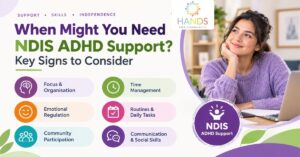
When Might You Need NDIS ADHD Support?
1. Daily routines are difficult to maintain.
Do you frequently struggle to get through everyday routines without reminders or assistance?
ADHD can make seemingly simple tasks difficult to organise. Getting ready for work, preparing meals, completing household tasks, managing appointments, or following a regular sleep routine may become overwhelming.
If maintaining a routine consistently requires prompting, supervision, or practical assistance, additional support may be worth discussing.
Support can focus on building predictable routines and breaking larger tasks into manageable steps. Over time, this may help you become more confident in managing daily responsibilities.
2. Organisation and time management are affecting your life.
For many people with ADHD, managing time is a major everyday challenge.
You may regularly:
- Forget appointments or important tasks
- Underestimate how long activities will take
- Miss deadlines
- Struggle to prioritise tasks
- Lose important items
- Have difficulty following schedules
- Feel overwhelmed by multiple responsibilities
These challenges can affect employment, education, household responsibilities, and social commitments.
NDIS ADHD support may assist eligible participants with developing practical organisational strategies, using schedules, and improving time-management skills.
The focus should be on building skills that work for your lifestyle rather than expecting you to follow a system that does not suit you.
3. Emotional regulation feels overwhelming.
ADHD can sometimes be associated with difficulties managing emotional responses. Frustration, stress, disappointment, or unexpected changes may feel particularly difficult to manage.
You may notice that emotional reactions affect relationships, work, social situations, or your ability to complete everyday activities.
If emotional regulation difficulties are significantly affecting your daily functioning, support may help you develop coping strategies and recognise situations that can trigger stress or frustration.
Hands for Community supports participants experiencing emotional regulation challenges and related difficulties as part of its ADHD support services.
4. You need regular prompting to complete everyday tasks.
Everyone forgets things occasionally. However, if you consistently need another person to remind, prompt, or guide you through everyday activities, this may indicate that additional support could be useful.
For example, you may need reminders to:
- Take part in planned activities
- Complete household tasks
- Attend appointments
- Prepare meals
- Follow personal routines
- Organise belongings
- Manage schedules
The NDIS considers functional capacity across areas such as learning, communicating, socialising, looking after yourself, and managing your life. Support needs can therefore be relevant when ADHD-related impairment substantially affects everyday activities.
5. ADHD is affecting your ability to participate in the community.
Community participation is an important part of independent living.
However, planning and attending activities may become difficult when you experience problems with organisation, communication, focus, anxiety, or emotional regulation.
You might avoid social activities because they feel overwhelming, struggle to attend appointments independently, or find it difficult to participate in community activities without assistance.
Appropriate support can help participants work towards greater confidence in accessing their community, attending activities, and developing social skills.
Hands for Community provides community access and participation support as part of its broader disability services in Sydney.
6. ADHD is affecting work or study.
ADHD-related challenges can make employment or education more difficult.
You might struggle with:
- Following instructions
- Staying focused on tasks
- Managing deadlines
- Organising work
- Switching between activities
- Communicating with others
- Maintaining consistent routines
The NDIS considers whether a person’s impairment affects areas such as work, study, or social participation when assessing disability requirements.
If ADHD significantly affects your ability to manage everyday responsibilities associated with work or study, it may be useful to discuss your support needs with your healthcare professionals and NDIS contacts.
7. Social communication is becoming a barrier.
ADHD can affect communication and social interactions for some people.
You may find it difficult to:
- Wait for your turn in conversations
- Stay focused when someone is speaking
- Recognise social cues
- Control impulsive responses
- Maintain relationships
- Manage conflict
- Participate comfortably in group situations
These challenges can sometimes contribute to isolation, frustration, or low confidence.
Individualised support can provide opportunities to practise communication and social skills in everyday situations while working towards personal goals.
8. You are finding independent living increasingly difficult.
One of the most important questions to ask is
“How much is ADHD affecting my ability to manage everyday life independently?”
If you regularly depend on family members, friends, or carers to manage tasks that you would otherwise like to do independently, it may be time to consider what additional support could look like.
This could include assistance with routines, household activities, appointments, community access, transport, or developing practical life skills.
The aim should be to support independence rather than create unnecessary dependence.

Does Having ADHD Automatically Make You Eligible for the NDIS?
No.
Having an ADHD diagnosis does not automatically mean someone is eligible for the NDIS. Eligibility is based on specific requirements, including age, residency, and disability or early intervention requirements. Under the disability requirements, the NDIS considers whether an impairment is likely to be permanent, substantially reduces functional capacity, affects areas such as work, study, or social participation, and is likely to require NDIS support for the person’s lifetime.
Evidence from doctors, specialists, or other treating professionals may be needed to demonstrate how the impairment affects everyday life.
This means it is important to focus not only on the diagnosis but also on the functional impact of ADHD.
What Can NDIS ADHD Support Look Like?
For an eligible participant, support needs can vary considerably.
Depending on individual goals and approved supports, assistance may focus on areas such as:
- Developing daily routines
- Managing schedules and appointments
- Building organisational skills
- Improving time-management strategies
- Developing communication skills
- Supporting community participation
- Building confidence and independence
- Managing everyday activities
- Developing life skills
- Providing assistance with transport and access
Hands for Community provides ADHD support for participants aged 15–65 in Sydney, with services designed around individual routines, communication styles, goals, and support requirements.
Why Individualised Support Matters
There is no single approach that works for everyone with ADHD.
One participant may need help establishing a morning routine. Another may need support with community participation, emotional regulation, or organising appointments.
Effective support starts by understanding the person’s strengths, challenges, preferences, and goals.
At Hands for Community, support workers work with participants to encourage skills such as routine management, organisation, communication, emotional well-being, and community participation.
The long-term focus can be on helping participants feel more capable of managing their everyday lives while maintaining choice and control over their support.
When Should You Ask for Support?
You do not have to wait until everyday challenges become overwhelming before talking about support.
If ADHD is consistently affecting your ability to manage routines, organise your life, participate socially, attend appointments, study, work, or live independently, it may be worth discussing your circumstances with your healthcare professional and NDIS contacts.
Keep track of the areas where you experience difficulties. Examples of daily challenges, support requirements, and functional impacts can help provide a clearer picture of your needs.
Remember that NDIS eligibility and funding decisions are made according to NDIS requirements and individual circumstances. A support provider cannot guarantee that someone will be accepted into the NDIS or that a particular support will be funded.

Get NDIS ADHD Support in Sydney
ADHD can affect different areas of everyday life, but the right support can help eligible participants work towards greater independence, confidence, and participation.
If you or someone you care for is experiencing ongoing difficulties with routines, organisation, emotional regulation, communication, community participation, or daily living, NDIS ADHD support may be worth considering.
Hands for Community provides personalised ADHD support services for eligible participants across Sydney, with support focused on individual goals, daily needs, and independence.
Ready to discuss your support needs?
Hands for Community 0413 522 162
 contact@handsforcommunity.com.au
 https://handsforcommunity.com.au/
 408/29-31 Lexington Drive, Bella Vista NSW 2153
Reach out to Hands for Community to discuss how personalised NDIS disability support may assist with your everyday goals and support needs.